

Holography is one of the most significant advancements in education today. The use of 3D holographic learning environments will transform the way we teach and learn, as they provide students with the ability to experience learning in a highly realistic, engaging, and memorable way. Holography will provide teachers with an efficient way to teach their subjects using holographic learning tools, which have already proven to be an effective method of teaching for the last few years. Teaching with holograms, holograms for education, and teaching holographically are all very effective ways to enhance the engagement, personalization, and comprehension of any subject being taught to students of all ages in this current academic digital-first atmosphere.
Educational holography is the representation of concepts, objects, and settings that are three-dimensionally viewed as holograms for real-time instruction. Unlike video or animation, holograms create spatial depth, enabling learners to view content from multiple angles.
Educational applications of holography provide a means to simplify complex topics (e.g., anatomy, engineering, astronomy, and chemistry) by transforming abstract concepts into 3D experiences that can be visualized from multiple angles. Additionally, the learning approaches enabled by educational holography support different types of learners (e.g., visual, auditory, and kinesthetic). They also enhance students' ability to remember information and encourage curiosity and self-exploration of the content.
For many years, the inability to engage students in learning has been a persistent challenge for educators who teach traditional classroom courses. Educational holography aims to address this issue by making the learning process interactive and visual.
It means that with holograms in education, students can:
Holography in learning converts passive listening to active participation, improving focus and reducing cognitive fatigue. When students engage multiple senses, comprehension naturally improves.
Whereas traditional teaching tools, such as slides and videos, have limited visual depth, teaching with holograms introduces spatial realism that better matches how the human brain processes information.
The benefits of holograms in education include:
Holography in education bridges the gap between theory and reality, particularly in the fields of science, technology, engineering, and mathematics.
Classroom holographic displays enable educators to present their lessons in a more visually rich and interactive format. With the ability to rotate, zoom, and otherwise manipulate holographic content in real-time, the teachers can adapt lessons instantaneously based on student responses.
These displays support:
Integrating holography into daily teaching, educators move away from the lecture model towards a facilitator of exploration.
Various disciplines are being reshaped by their applications in educational holograms:
Students study organs, cells, and operations using photo-realistic holographic models to increase accuracy and confidence.
Holographic prototypes will enable learners to study the structures, mechanics, and design flaws well before actual physical construction.
Holograms recreate ancient civilizations, battlefields, and geographical formations, making the lesson emotional.
Virtual holographic characters are also supported for immersive language practice and cultural understanding.
These educational hologram applications really prove that learning with holography enhances knowledge and creativity.
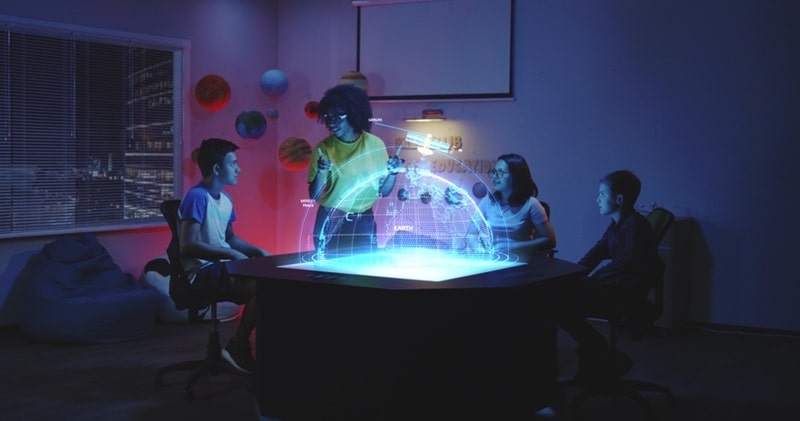
Not everyone learns the same. Learning with holography indeed supports all three learning styles relevant to most texts: visual, auditory, and kinesthetic learners.
Educational holography ensures inclusivity by considering diverse cognitive needs.
Yes, research across the board shows that immersive learning enhances retention. Teaching with holograms enables experiential learning, strengthening neural connections.
Students remember:
It turns lessons into experiences, which in turn stick longer and more deeply.
Remote education often lacks engagement. Educational holography solves this by bringing presence into the virtual space.
With holograms in education:
This turns classroom holographic display systems into powerful aids for hybrid and distance learning models.
Adoption is accelerating. An increasing number of universities, medical schools, and training institutions worldwide are incorporating educational holography into their curricula.
Its adoption drivers include:
As a result of the increasing digital literacy, teaching with holograms will soon become a norm rather than a novelty.
Consequently, despite the advantage of educational holography, it often faces some issues or drawbacks:
Barriers that once seemed insurmountable could fade away quickly, considering that scalable versions of hologram applications are being created for educational purposes.
Educational Holography will rely heavily on AI, VR, and adaptive learning systems in the future. Soon enough, holographic images will respond to students’ behavior, create individualized lesson plans in real time, and offer predictive support for student learning.
Some examples of new technologies being developed include:
The future of holography in education will continue to shape how we teach students in the years to come.
Educational holography lies at the intersection of technology and pedagogy, encouraging creativity, democratizing access to quality education, and better equipping learners to engage in real-world problem-solving.
In the Innovation & Trends landscape, educational holography is leading the way in transforming classrooms, redefining what learning actually entails.
Holographic education is more than just a teaching tool; it is a philosophy of learning transformation. Tying together the use of holograms in education, Classroom Holographic Display, and teaching with holograms creates an immersive, inclusive, and impactful learning environment.
In the near future, education holography will become very fundamental in institutions that need to provide students with quickly changing environments.
These then serve in the education sector for the visualization of complex subjects in three dimensions, enabling students to understand concepts better with immersive and interactive learning environments.
Holograms make education more interactive, spatially understandable, and memorable because lessons become experiences.
Indeed, holographic teaching will help learners of all ages, starting from elementary students to advanced professional training programs.
Holographic displays at the school mostly require projection hardware, compatible software, and a controlled lighting environment to display images in the best possible way.
This content was created by AI