

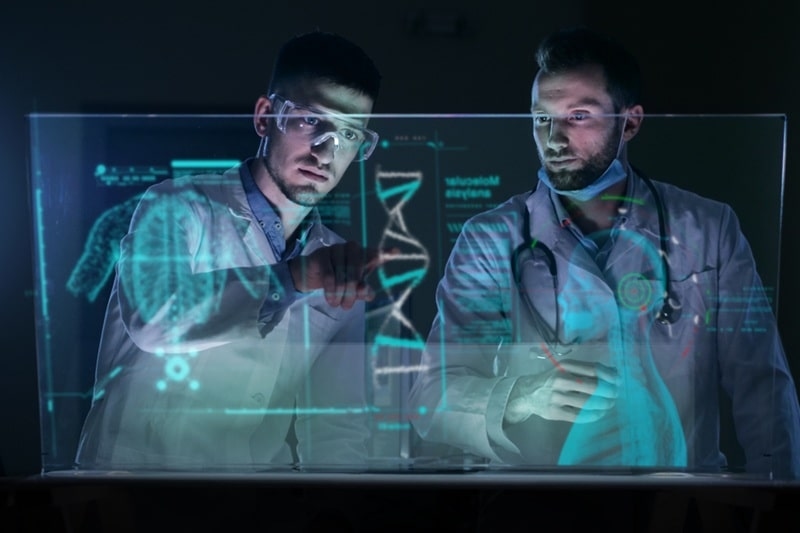
Medicine has always relied on vision. Doctors look at scans. Charts. Images on screens. They interpret shadows and slices and cross sections, then mentally rebuild the human body in their heads. It works, but it is demanding. And sometimes, those flat images leave room for doubt.
Now imagine standing in a room where a patient’s heart floats in front of you. You can walk around it. Look inside it. Enlarge a valve. Trace a vessel with your finger. All without touching the patient.
That is not science fiction anymore. This is medical holography, and it is quietly changing how doctors understand the human body, make decisions, and in many cases, save lives.
Medical holography takes existing scan data and turns it into three dimensional, spatial visuals that appear to exist in real space.
Doctors do not just view images. They explore them.
Organs are no longer diagrams. They become objects with volume and relationships. Surgeons can see how a tumor wraps around a vessel. Cardiologists can examine structural defects from every angle.
This shift from interpretation to exploration changes how medical teams think and communicate.
Traditional medical imaging has limits. CT scans, MRIs, and ultrasounds are powerful, but they flatten complex anatomy into two dimensional views. Doctors flip through slices and reconstruct depth mentally. That takes experience, time, and sometimes guesswork.
In routine cases, that works fine. In complex cases, it can slow decisions or introduce uncertainty.
Healthcare needed a way to see anatomy as it actually exists. In space. With depth. With context.
That need opened the door for holograms in medicine to move from experimental labs into real clinical environments.
Diagnosis often depends on pattern recognition.
Subtle differences in shape, size, or position can matter. Flat screens hide some of that nuance.
With medical holographic imaging, clinicians can isolate structures, remove visual clutter, and focus on exactly what matters. They can zoom, rotate, and annotate in real time.
This helps in identifying abnormalities earlier and with greater confidence, especially in complex anatomical regions like the brain, heart, and spine.
Surgery planning is one of the most impactful uses of holography.
Before entering the operating room, surgeons can rehearse procedures using patient specific holograms. They can test approaches. Identify risks. Adjust strategies.
These surgical holograms act like detailed maps, reducing surprises once surgery begins.
Better planning often means shorter operations, fewer complications, and faster recovery for patients.
During surgery, seconds matter.
Holographic displays can be referenced mid procedure without breaking sterile fields. Surgeons can glance at spatial data instead of switching focus to distant monitors.
This keeps attention where it belongs. On the patient.
The integration of holography into surgical workflows supports precision without adding distraction.
Medical training has always balanced learning with safety.
Cadavers, simulations, and supervised practice help, but they have limits. Holography adds a new layer.
Students can explore realistic anatomy repeatedly. They can practice procedures visually before performing them physically. Mistakes do not harm anyone.
This makes healthcare holography applications valuable not just for experts, but for building the next generation of doctors.
Holography shines when cases are complicated.
Congenital heart defects. Brain tumors. Rare anatomical variations. These situations challenge even experienced teams.
Seeing anatomy in three dimensions helps teams align faster. Surgeons, radiologists, and specialists can gather around the same hologram and discuss options together.
Shared understanding reduces miscommunication.
Patients often struggle to understand their conditions.
Explaining surgery with flat images can be confusing. Holograms change that.
Doctors can show patients what is happening inside their bodies. They can point to areas of concern. Explain procedures visually.
This transparency builds trust and helps patients make informed decisions about their care.
In trauma and emergency care, time is critical.
Quick understanding of injuries guides life saving decisions. Holographic visualization can accelerate assessment by revealing spatial relationships instantly.
When every minute counts, clarity matters.
This is where diagnostic holographic technology begins to show its full potential under pressure.
Healthcare is not evenly distributed.
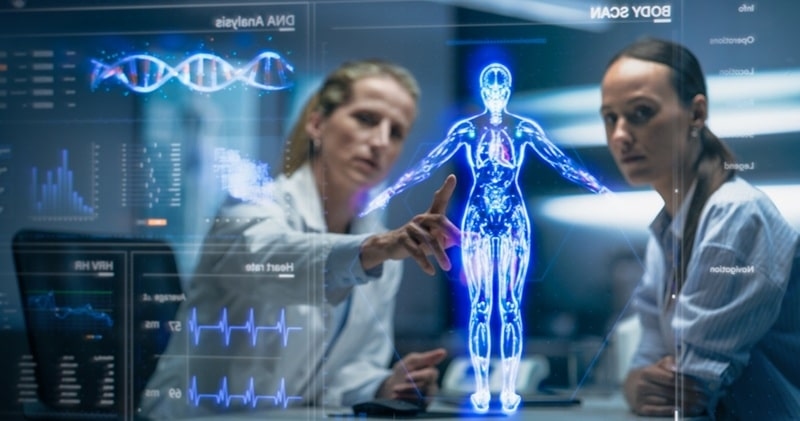
Specialists may be far away. Holography enables remote experts to view the same patient data in three dimensions, even from different locations.
They can discuss cases collaboratively, pointing to the same structures, sharing insights in real time.
This expands access to expertise without moving patients.
Medical holography is powerful, but it is not perfect.
Hardware costs can be high. Training is required. Integration with existing systems takes time. Not every hospital is ready.
There are also regulatory considerations. Medical tools must meet strict safety and accuracy standards.
Adoption is growing, but thoughtfully.
Doctors are cautious by nature.
They adopt tools that prove value, not trends. Holography earns trust by enhancing existing workflows rather than replacing them.
It builds on familiar imaging data and adds clarity. It does not ask doctors to relearn medicine. It helps them practice it better.
That is why medical holography continues gaining traction across specialties.
Early adopters report tangible benefits.
Shorter surgery times. Better pre operative planning. Improved communication across teams. Greater patient understanding.
These are not abstract wins. They affect outcomes.
And when outcomes improve, adoption follows.
Technology should serve humanity, not overshadow it.
Holography supports human judgment rather than replacing it. Doctors still decide. They simply see better.
Maintaining that balance matters. Patients are people, not data sets.
The best holograms in medicine respect that distinction.
As hardware becomes lighter and software more intuitive, holography will become more common.
Integration with AI may enhance pattern recognition. Wearable displays may improve mobility. Costs will likely fall.
What feels advanced today may become standard tomorrow.
Better visualization leads to better decisions.
Better decisions lead to safer surgeries, faster diagnoses, and clearer communication.
In medicine, that chain matters.
Medical holography does not save lives on its own. Doctors do. But it gives them a clearer view when it matters most.
Medicine relies on shared understanding.
Holography creates a common visual language across disciplines. It bridges gaps between data and intuition.
That shared clarity improves care at every level.
The human body is complex. No single image can capture it fully.
Medical holography brings doctors closer to seeing that complexity as it truly exists. In space. In context. In motion.
It turns data into understanding. And in healthcare, understanding saves lives.
Medical holography uses three dimensional holograms created from medical imaging data to help doctors visualize anatomy more accurately.
Yes. Medical holography is non invasive and uses existing scan data, adding no risk to patients.
It is increasingly used in advanced hospitals and research centers, especially for surgery planning, training, and complex diagnostics.
This content was created by AI