

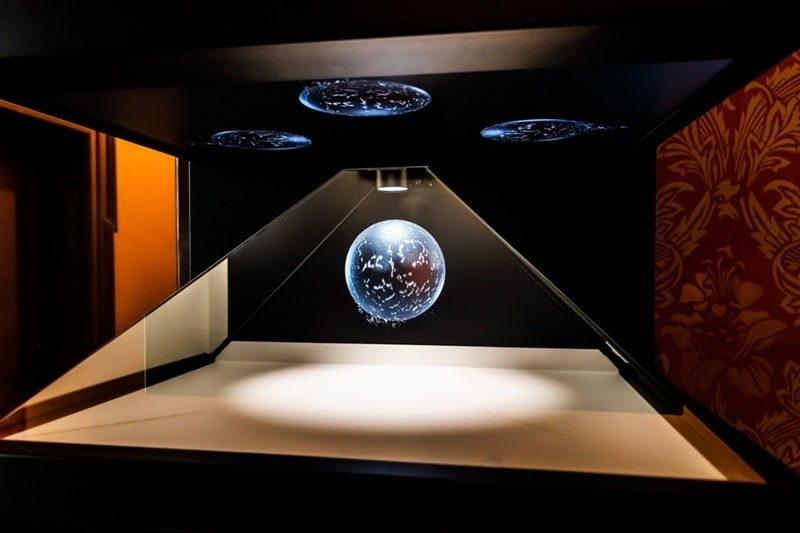
Volumetric displays are a class of graphic displays that truly generate a three-dimensional hologram rather than a three-dimensional illusion, and thus are credited as displaying "true" three-dimensional images.
From scientists and engineers to fans of science fiction, the notion has long run riot that images could float freely in space, viewable from all sides without the use of special glasses. In recent years, this vision has started to make its way from fiction to reality thanks to volumetric display technology. Unlike traditional flat screens or illusion-based holograms, volumetric displays emit images that truly exist in three dimensions, enabling the viewer to walk around them and perceive depth, perspective, and true spatial realism.
With interest growing across healthcare, defense, education, automotive design, and entertainment in the United States, the need to understand what constitutes volumetric displays in simple terms is becoming increasingly paramount. Here, we explore volumetric displays explained, how they work, the different types of volumetric projection systems available today, and why they are considered the future of true 3D volumetric screens.
First and foremost, volumetric displays clearly necessitate a conceptual recalibration in the way we have thus far perceived visual media. Traditional screens—be they TVs, smartphones, or monitors—are two-dimensional surfaces that use visual cues such as shading, perspective, and motion to create the illusion of depth. Even 3D TVs and VR headsets merely rely on stereoscopic tricks, presenting each eye with slightly different images.
Volumetric display technology, on the other hand, presents images in physical space by illuminating points. These points, sometimes referred to as three-dimensional counterparts of the two-dimensional pixel-form shapes and images that occupy volumes in reality. Looking at the image from different angles naturally results in changes, just as one would expect from a real object.
That's why volumetric displays explained properly are often described as "walk-around visuals." There isn't a fixed position from which to view anything; there aren't any glasses to wear, and there isn't any illusion of depth-the depth is real.
Central to volumetric display technology is controlled light generation in three-dimensional space. Instead of projecting images onto a display surface, the system produces light at points in space described by coordinates x, y, and z, to build up an object that is visible in all its views, layer by layer or point by point.
Most systems depend upon one of three methods:
Regardless of the means, the goal remains to build true 3D displays that can be viewed from any angle without aids.
That is where the critical role of spatial display technology comes in, as it defines how depth, orientation, and volume are represented, ensuring that the image maintains its correct proportions and realism as the viewer moves around it.
There are several forms of modern 3D volumetric screens, each with distinct advantages and limitations. Being cognizant of these categories will help provide a better understanding of where the technology is today and where it's heading.
Swept-volume systems utilize a rapidly moving surface—a spinning screen or oscillating panel, for example—that images are projected onto at high speed. The human eye perceives a complete three-dimensional image due to persistence of vision.
These displays represent some of the most mature examples of volumetric display technology and find common use in research labs and industrial demonstrations. They offer very good depth accuracy and are ideal for applications such as medical imaging and engineering visualization.
Another approach to static systems is to use a fixed medium (fog, glass layers, crystal matrices) from which light can be emitted or scattered from many different depths; many volumetric projection systems rely on stacked layers or on crossing light beams.
While static volume displays have the potential to achieve high resolution, their performance may be mitigated by physical properties of the medium, such as transparency or light diffusion.
Probably the most exciting frontier in true 3D displays is free-space rendering. These systems use focused lasers to ionize air molecules, creating tiny points of light (plasma) that form visible shapes in midair.
While it is still largely experimental, free-space volumetric display technology represents the closest realization of science-fiction holograms and showcases the potential of advanced spatial display technology.
Volumetric projection systems shall not be confused with standard projectors. Traditional projection displays cast images onto flat surfaces-walls, screens, or domes. Even in immersive environments, the image itself remains two-dimensional.
Volumetric projection systems project light into a volume, rather than onto a surface. The image exists within the space, rather than on it. That is a very important distinction when discussing volumetric displays accurately, showing just why such a system would differ fundamentally from AR or VR.
In volumetric projection systems, the appearance of depth is not simulated-it is represented physically. For this reason, they see their biggest value in application fields relying on spatial accuracy, such as surgery planning, air traffic control, and scientific visualization.
Spatial display technology is a more general family of methods applied to embody spatial data through visualizations. Volumetric display technology represents one of the most sophisticated expressions of this concept.
Spatial display technology allows a more intuitive understanding of complex structures by directly mapping data into three-dimensional space. For instance, the three-dimensional volumetric display of the human heart lets doctors study the internal anatomy from any angle, thereby increasing clarity in diagnosis.
It enables engineering and design teams to share a visual model for collaboration around a shared understanding, thereby reducing misinterpretations and thus improving decision-making, because of the spatial display technology combined with 3D volumetric screens.

But one of the main reasons for the growing interest in volumetric display technology across the U.S. is its unique set of benefits.
In the United States, 3D volumetric screens are already finding their uses in several industries.
Mainly, volumetric display technology is used in healthcare to visualize MRI and CT scans, helping surgeons plan procedures with greater assurance. Volumetric displays are also adopted as advanced teaching tools within medical schools.
These systems were in operation in volumetric projection to support mission planning, radar visualization, and airspace monitoring in defense and aerospace. In such high-stake environments, spatial relationships need to be clear.
The volumetric displays, as described in the educational and research setups, enable interactive learning aids for students to view molecular structures, geological formations, and astronomical data in ways that are immersive.
This, however, does not come without its challenges: volumetric display technology faces cost as a big issue; most require high-end hardware and are never okay without proper calibration.
Then there's the issue of resolution. Since true 3D displays scatter light within a volume, reaching a high density of voxels is more challenging than simply increasing the density of pixels on the surface of a flat screen.
Among others, safety and scalability do matter, especially for laser-based volumetric projection systems. Eye safety, while keeping the brightness, is ensured by continuous research.
With increasing computing power and advancements in optical engineering, the prospects for volumetric displays continue to look brighter. Hybrid approaches are being researched that incorporate volumetric display technology with AI, real-time data processing, and advanced sensors.
In the near future, spatial display technology will become more compact, more affordable, and available to consumers. Indeed, such innovation can accelerate the diffusion of 3D volumetric screens into consumer products, museums, retail environments, and smart cities.
While volumetric displays explained today will continue to advance, it is obvious that they will shift our interaction with the digital beyond flat screens into shared three-dimensional visual spaces.
Volumetric display technology represents a radical paradigm shift in visual communication. By creating images that occupy real space, these systems transcend the limitations of flat screens and illusion-based 3D. From volumetric projection systems to advanced, true 3D displays, this technology is redefining the way professionals and everyday users understand complex information.
As spatial display technology continues to mature, volumetric displays, clearly explained today, will become the standard visual interfaces of tomorrow. For U.S. industries driven by innovation, precision, and teamwork, volumetric displays are not just a novelty; they are a game-changing phenomenon that shapes the future face of human-computer interaction.
Not precisely. Though volumetric displays are sometimes referred to as holograms, this is not a correct description of them. Volumetric display technology develops images in true physical space with voxels, which, in fact, is the only real method of 3D display that is viewable from any angle without glasses. Traditional holograms rely on the interference patterns of light or projection tricks on a flat surface. When volumetric displays are explained properly, they are closer to real three-dimensional objects than classic holographic illusions.
3D volumetric screens are mainly used professionally and in research settings throughout the U.S., ranging from medical imaging and surgical planning to aerospace and defense visualization, scientific research, and advanced education. It is expected that as spatial display technologies continue to become more accessible, volumetric projection systems could find applications in museums, exhibitions, and collaborative design.
Currently, all types of volumetric projection systems are mostly restricted to commercial and institutional use due to cost, size, and technical complexity. However, continuing advances in volumetric display technology and spatial display technology are gradually reducing these barriers. Someday, a simplified true 3D display might be available for home entertainment, gaming, and remote collaboration.
This content was created by AI